

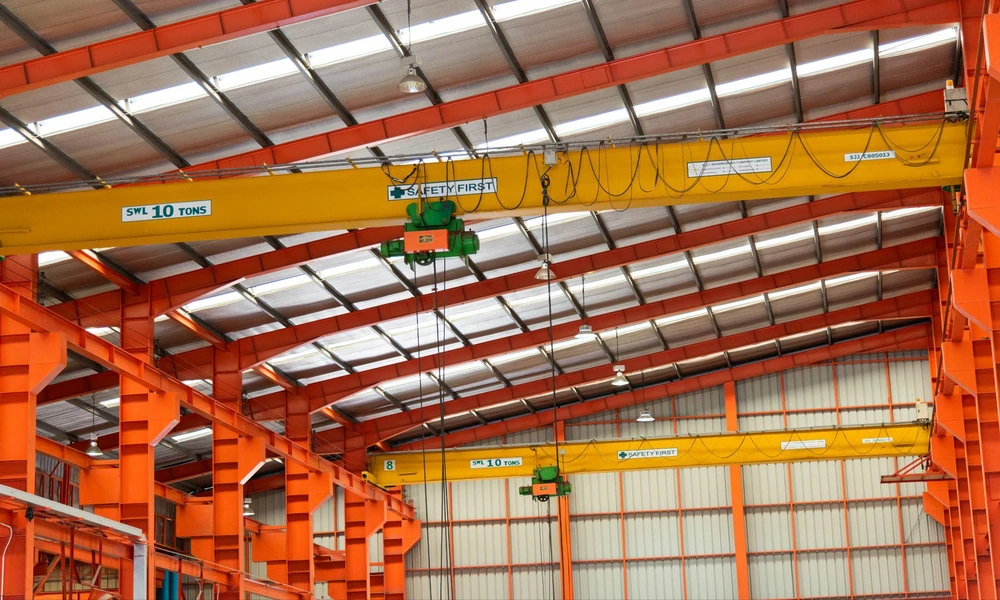
A lifting system should match the route materials needed to travel, especially when a facility handles repeated movements between the same work areas. In some workplaces, loads follow a predictable path from one stage of an operation to the next. A monorail crane may be a practical option when the facility benefits from a fixed lifting route rather than broad coverage across an entire area. Before selecting any equipment, operations planners should review how materials move through the workplace and whether a defined overhead path supports the existing layout and workflow.
1. A Linear Production Line
A linear production layout often moves materials through a sequence of workstations arranged in one direction. Components may begin at one end of the production area and move progressively towards later stages.
A monorail crane can suit this arrangement when loads repeatedly travel along the same overhead route. The system can support movement between defined points without requiring lifting equipment to cover unnecessary sections of the facility.
Before selecting this arrangement, planners should identify where materials enter the production line, where they need to stop and whether the required route remains consistent. Changes in the production process may alter the suitability of a fixed overhead path.
The available headroom and building structure also require assessment because they can influence the practical installation of the lifting system.
2. A Facility With Repeated Transfer Points
Some workplaces involve frequent transfers between a limited number of fixed locations. Materials may move from a storage point to a machine, from one processing station to another or from an assembly area to a finishing section.
When the same lifting route serves these transfer points repeatedly, a monorail crane may provide a practical way to support the workflow. Planners can map the required movement and assess whether a fixed path reaches each location without creating unnecessary travel.
This approach works best when the transfer pattern remains relatively stable. If loads need to move freely in several directions or across a wide open area, a different arrangement may be more suitable.
| Workplace layout | Typical material movement | Suitability for a fixed route |
| Linear production line | Loads move through sequential workstations | May suit a monorail arrangement |
| Repeated transfer points | Materials travel between fixed locations | May suit a defined overhead path |
| Narrow or elongated workspace | Movement follows the length of the facility | Can support route-based lifting |
| Segmented production process | Loads move through connected operating stages | May suit a planned fixed route |
3. A Narrow or Elongated Workspace
Facilities with long and narrow layouts may create a natural path for material movement. In these environments, materials may regularly travel along the length of the workspace rather than across its full width.
A monorail crane can follow this direction when the required lifting route remains predictable. This can allow planners to design the lifting path around the facility’s physical shape and the location of work areas.
However, the route should not be determined by the building shape alone. Planners should examine where loads actually need to travel and whether workers or equipment may require access beneath the overhead system.
The location of doors, machinery and storage areas can also affect whether a fixed lifting path works without disrupting daily activity.
4. A Segmented Production Process
Some operations divide production into connected stages, with materials moving in a repeated sequence between defined sections. Each stage may involve different equipment or tasks, but the movement between stages remains predictable.
A fixed lifting route may be practical when loads need to travel through the same sequence repeatedly. The route can reflect the actual production flow and support transfers between designated areas.
Before choosing this approach, planners should consider whether the process may change. New machinery, altered workstations or changes in production volume can affect the route and potentially reduce the usefulness of a highly fixed arrangement.
Conclusion
A monorail crane may be a practical choice when materials follow a predictable path through a facility. Linear production lines, repeated transfer points, narrow workspaces and segmented processes can all create situations where a fixed lifting route deserves consideration.
The key planning step is to map how loads actually move. A lifting system should follow the operational route rather than force the workflow to adapt around the equipment.
Contact Shin Guan to discuss your facility layout and assess whether a monorail crane suits your material movement and lifting requirements.
