

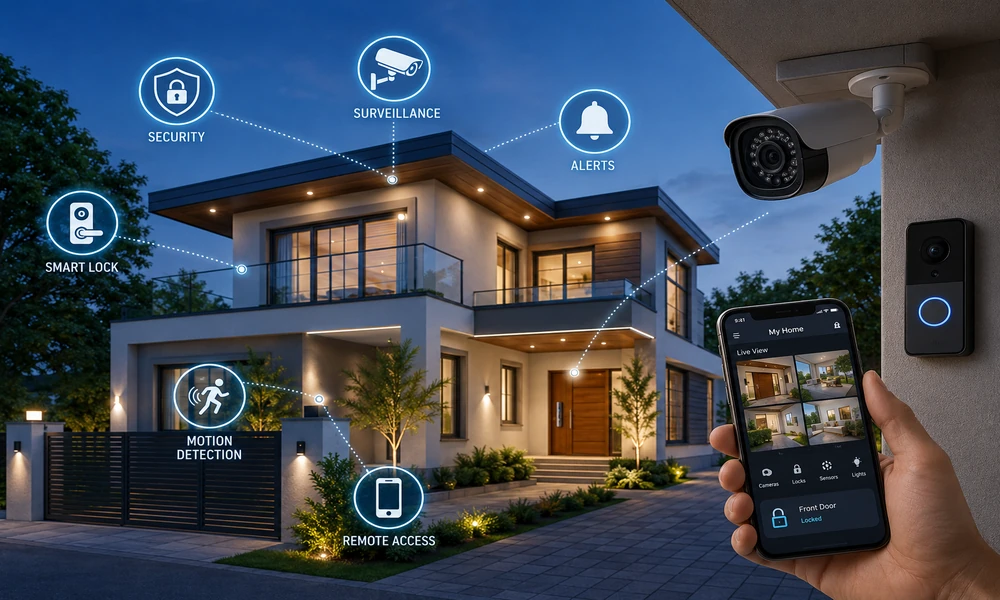
Most homeowners picture a flashing keypad and a siren when someone says “home security.” That mental image is about 30 years out of date. Today’s residential security platforms are closer to a diagnostic network than a burglar deterrent, monitoring invisible threats inside the home just as aggressively as forced entry at the front door. That shift matters, and understanding it could be the difference between a protected household and one that’s dangerously exposed.
The Sensor Ecosystem That Replaced the Simple Alarm
A traditional burglar alarm did one thing: detect an intruder crossing a threshold. A modern security system does that, plus monitors glass breakage, smoke, heat anomalies, water intrusion, and airborne gases, all from a central hub that sends real-time alerts to your phone and a professional monitoring center.
The expansion happened because the threat map for a home is wider than most people realize. Burglary is frightening. But a gas furnace venting improperly on a cold January night is statistically more lethal, and you’ll never sense it coming without dedicated detection technology. That’s exactly why the smartest security installs of the past few years treat life-safety sensors as first-tier components, not optional add-ons.
Think about what a fully integrated setup now triggers automatically when a carbon monoxide sensor trips: the HVAC system shuts down to stop circulating contaminated air, smart locks disengage so emergency responders can enter without breaking a door, and connected lighting illuminates exit paths. A standalone battery-powered alarm just beeps. The gap between those two outcomes is enormous.
Carbon Monoxide: The Threat That Made Sensor Integration Non-Negotiable
Carbon monoxide changed the conversation around home safety sensors more than any other single hazard. In 2022, 1,244 people in the US died from carbon monoxide poisoning, according to provisional CDC data. More people died from accidental CO poisoning in 2022 than any year since at least 1999. Those numbers alone justify treating CO detection as a core security function, not a checkbox.
What makes CO uniquely dangerous for homeowners is that it exploits exactly the moments when a security system should be most alert. A furnace that starts misfiring at 2 a.m., a water heater venting improperly in an attached garage, a generator running too close to a window during a storm: these are quiet, overnight events. By the time symptoms appear, cognitive function is already impaired. You are, functionally, asleep and unable to respond.
Professional monitoring solves that gap. When a sensor trips and a monitoring center dispatches emergency services, the response happens whether you’re unconscious, away from home, or simply didn’t hear an alert. That’s the core argument for integrating CO detection into a broader security platform rather than treating it as a separate, standalone device on a shelf.
For homeowners in the Southeast, where older housing stock often mixes natural gas appliances with less aggressive winterization habits, the risk concentrates in predictable seasonal patterns. Families looking at carbon monoxide protection for Atlanta homes are contending with exactly this combination: gas furnaces that may sit idle for months and then run hard when a cold snap hits in December or January.
Why Standalone Detectors Fall Short: A Sensor Priority Matrix
Here’s a framework worth keeping in mind when you’re evaluating any home security setup. Call it the Sensor Priority Matrix. Every sensor in a home falls into one of three tiers based on two variables: how fast the threat escalates and whether the threat is detectable by human senses without a device.
| Threat Type | Escalation Speed | Humanly Detectable? | Priority Tier |
|---|---|---|---|
| Carbon monoxide leak | Hours | No | Tier 1 (Critical) |
| Structure fire | Minutes | Yes (smoke, heat) | Tier 1 (Critical) |
| Forced entry | Seconds | Yes (sound) | Tier 1 (Critical) |
| Water/pipe leak | Hours to days | Partially | Tier 2 (Important) |
| Package theft | Minutes | Yes (visual) | Tier 2 (Important) |
| Motion in driveway | Seconds | Yes | Tier 3 (Awareness) |
The Tier 1 category is non-negotiable. Any security system that handles forced entry but skips CO detection has a blind spot in the exact zone where blind spots are most dangerous. Build your sensor layer from the top of this matrix down, never the other way around.
The Coverage Gap Hiding in Plain Sight
Despite years of public awareness campaigns, a staggering number of homes remain unprotected. One-third (36%) of U.S. adults, representing 86.2 million individuals, have no means of detecting CO leaks in their homes. That number comes from UL Standards and Engagement research published in 2024, and the organization’s vice president of standards development put the consequence bluntly: “Detection is prevention,” said Dr. George Borlase. “Because CO is colorless and odorless, a CO alarm is essential.”
That’s 86 million households operating with a sensor gap in the most critical tier of home safety. And it’s not a cost issue, since CO detectors integrated into a monitored security system don’t carry the premium most people assume. It’s mostly an awareness and installation friction issue: people don’t prioritize what they can’t see.
What Professional Installation Actually Changes
You can buy a CO detector at any hardware store. The question isn’t whether you can own the device; it’s whether the device is doing its job at the moment it needs to.
Placement matters more than most people realize. A CO detector mounted in the wrong room, too close to a fuel-burning appliance, or at the wrong height relative to your HVAC return vents can deliver a late or false alert. Professional installers who work with the full layout of a home, not just a single room, can map sensor placement against your actual appliance sources: the furnace in the basement, the water heater in the utility closet, the gas range in the kitchen, the attached garage where a running car or generator poses the highest acute risk.
Beyond placement, a professionally monitored CO sensor feeds into a system that acts without you. If gas levels spike at 3 a.m. and your household doesn’t respond to the alarm within a set window, the monitoring center calls emergency services. An estimated 76 percent of carbon monoxide poisoning cases occur in residential settings , according to a 2025 U.S. House Resolution citing federal data, which means the vast majority of incidents happen in the exact environment where professionally monitored detection could intervene.
“Because CO is colorless and odorless, a CO alarm is essential. The work we do in standards development is critical to protecting individuals from this silent killer.” — Dr. George Borlase, Vice President of Standards Development, UL Standards & Engagement (2024)
Building a Modern System: A Practical Checklist
If you’re reviewing or upgrading a home security setup, work through these questions in order:
- Do you have at least one CO detector on every floor with sleeping areas? Current guidance from the U.S. Consumer Product Safety Commission, which tracks annual CO deaths from consumer products, emphasizes coverage near bedrooms where occupants are asleep and unable to self-evacuate.
- Are your detectors wired into your monitored security system or standalone? Standalone devices rely on you waking up and responding. Monitored devices call for help on your behalf.
- When were your detectors last tested? Most electrochemical CO sensors have a rated lifespan of five to seven years. Older units may not respond to lower-level, chronic exposures.
- Do you have fuel-burning appliances or an attached garage? If yes, you are in a higher-risk category by default and should treat Tier 1 sensors as mandatory, not optional.
- Does your security provider offer 24/7 professional monitoring tied to life-safety sensors? A system without monitoring is an alarm. A system with monitoring is a response.
The homeowners who skip this audit typically do so because nothing bad has happened yet. That reasoning is exactly as reliable as it sounds. The science on CO, confirmed by USAFacts reporting on 2022 CDC data, shows that accidental CO deaths are rising, not falling, which makes this the wrong moment to assume your current setup is enough.
The Right Way to Think About Home Security Now
A locked door is not a security system. Neither is a camera pointed at the driveway. Real protection in 2025 means layers: intrusion detection at the perimeter, life-safety sensors for invisible threats inside the envelope of the home, and professional monitoring to close the gap when you’re asleep, distracted, or simply unable to respond in time.
The shift from “burglar alarm” to “integrated safety platform” is already complete among the best residential security providers. The remaining question is whether your home has caught up. Start with the Sensor Priority Matrix, fill your Tier 1 gaps first, and make sure every sensor in that tier feeds a monitoring center that can act without you. That’s the standard worth holding.
